

This week has seen unions get more rights around elections and strike votes, with the government overturning a decades-old ban on unions voting by any other means than post. From 25 August 2026, we can now consult our members in ways that the majority of them would expect from us – using email, SMS or other electronic means.
TUC Education ran a webinar with trade union reps, looking at what’s in the new rules, and how ready we think we are for it. Over 1,400 signed up for it, and we got some really useful feedback back from the reps who took part. Here are a few reflections on what we heard on the call.
Reps themselves are ready for this
The new rules mean unions can finally join the UK’s other organisations and businesses, which have been successfully using these tools for more than 20 years. We asked reps how many of them had already used electronic voting in non-union elections.
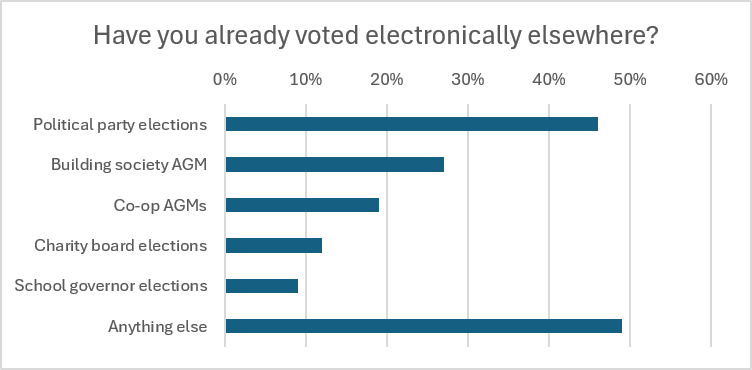
The list was topped by political party elections, which 46% of reps had already taken part in online. 27% had voted online in a building society AGM, with other governance elections scoring pretty well too.
That’s a significant number of reps who are already well used to exercising their democratic rights online.
And their members are likely to be ready as well
We asked reps to score how likely the membership of their branches were to be able to cast a vote online, using a scale where 10 meant “no member would have a problem with this”, and 1 meant “no member would be able to do this”.
63% voted 8/10 or more, suggesting a large majority of members will probably be fine using the new tools, but we may need to consider fallback methods in ballots where the electorates are less ready.
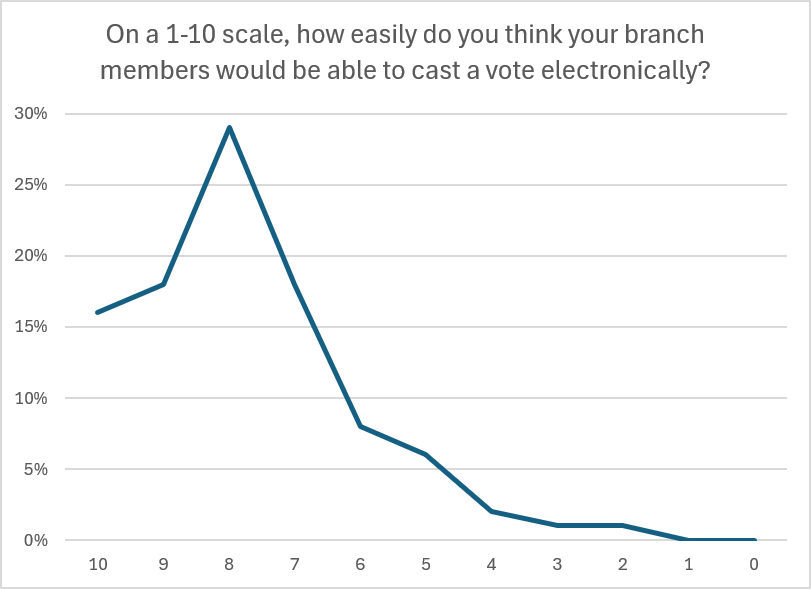
Lots of reps could speak with authority on this because they’ve already been using electronic means to run indicative ballots, branch elections or pay consultations. They had seen some pretty good levels of success that they were keen to replicate in statutory ballots.
“We always get much higher turnout on online consultative ballots compared to postal ballots.”
“Electronic votes have been 20% higher than postal.”
Accessibility was a big issue here, and reps told us that it cut both ways. Whilst older members, or those who might not be able to afford a smartphone, could be disadvantaged by a move to technologies they weren’t familiar with, there was also a recognition that digital improved access for members with visual impairments, in temporary accommodation, or for younger members. Consensus seemed to settle around how we provide for fall-backs or hybrid options that mean members aren’t excluded.
Frustration with postal voting runs pretty deep
And the mirror to electronic voting being easy for most members is that postal voting causes problems.
Reps told us about:
- delayed ballot papers arriving only on deadline day
- replacement ballots never arriving
- post disappearing in blocks of flats and shared addresses
- gaps in service meaning members miss post for weeks
- members working overseas or travelling missing ballot papers
Whilst the electronic regulations rightly consider security and deliverability, it’s clear that the existing regulations had been glossing over some very big holes in those for postal voting.
Members seem to be in a similar place too, with some reps telling us they encounter frustration in the branch when they have to persuade members to take part in postal ballots:
“Members always ask if they can vote online.”
“Members actually asked if they could vote online.”
“Trade unions aren’t living in the past.”
Reps think turnout will improve, but it won’t be automatic
Making a task easy isn’t the whole battle in getting someone to do it, you still need to work on motivation (read more on that here).
We heard some interesting comments around this, suggesting reps are realistic about how much this is going to change overnight.
Unions will need to work on improving engagement levels with members at both national and branch levels if we’re going to be able to mobilise them to vote at scale.
“I think members would be confident voting this way, but I’m not sure how many would actually vote.”
“Our major problem is half our members don’t open the emails.”
And getting personal contact data is going to be a fundamental issue
The technology will also only be as strong as the data behind it. There was a concern that many members preferred to use workplace email in their engagement with the branch. That’s a problem, as the first phases of online balloting will only be allowed to use personal email addresses.
“Most members in my branch receive union comms to their work email.”
“It’s going to be hard to get personal emails from people who prefer to use work emails.”
Reps suggested there would be a lot of work to do to convince members of the need to register a personal email address with the union. And then there would be an ongoing battle to keep those contact details up to date.
Why electronic balloting matters to union reps
We asked reps on the call to tell us what they thought the biggest benefit to their union might be from a move to electronic balloting. There were a huge range of ideas here, but we’ve grouped them into 9 main themes.
| Higher turnouts / beat thresholds | 31.7% |
| Cost savings | 16.6% |
| Faster ballots | 12.8% |
| Reduce dependence on post | 12.8% |
| Higher member engagement | 9.3% |
| More efficient processes | 7.3% |
| Accessibility | 6.1% |
| Modernise union democracy | 1.9% |
| Environmental benefits | 1.6% |
It’s clear that the largest group are looking to get an increase in turnout. That, potentially combined with faster ballots could do a lot to increase our industrial power.
Saving money and improving efficiency are also going to be important in making our unions sustainable into the future. And improving engagement, building accessibility and democracy are all critical for meeting our members’ expectations from us, and building the capacity of our branches.
Thanks very much to all the reps who joined in and shared their thoughts. If you didn’t see it and would like to watch the webinar, here’s the recording.
And thanks to the brilliant team at TUC Education. You can catch their wider programme of webinars and learning for reps on their website here.