
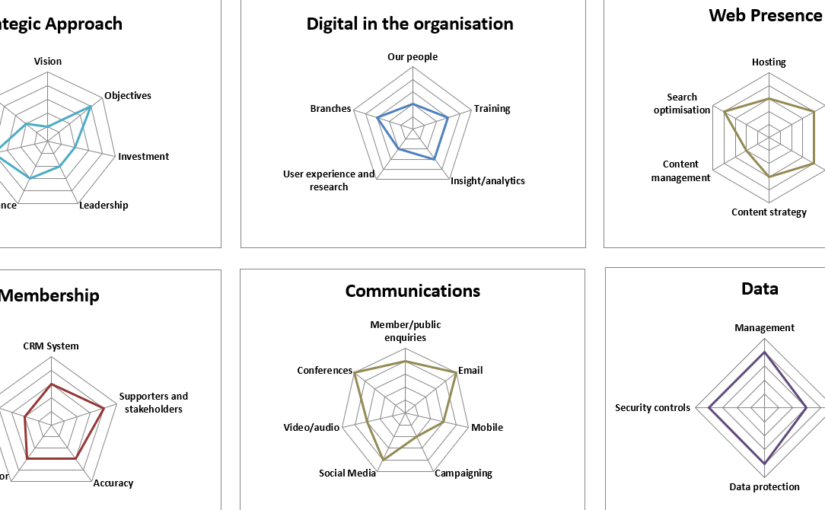
We’ve just released the latest major version of the TUC’s digital healthcheck tool, version 4.01. It’s been more than five years since our last version, so we wanted to revisit it and make some changes to reflect the fast-moving world of technology.
What’s different, and what’s the same?
We’ve looked across the whole tool to update the different stages of good practice for unions on tech and digital. It’s been interesting to see what’s held up well, but also where new ways of working with tech can be seen coming through.
Since the last update, we’ve seen a continued move to the cloud for tech services. There’s also been a particular emphasis on doing tech with a greater eye on security, as unions have faced an increasing level of cyber attacks. And as emerging technologies like AI start to embed into more tech tools, unions need to consider the longer term view in how we’re responding.
At the same time, we’ve tried to keep as much consistency in theming and levels as possible. So unions using it should still be able to identify clearly where they are making progress from previous iterations.
What is the digital healthcheck?
For those who’ve never used the digital healthcheck before, it’s a tool to help unions benchmark their digital and technical maturity. Working through questions in an interactive Microsoft Excel spreadsheet, you choose the best fit for where your union currently stands across a broad range of categories.
Its purpose is to help benchmark your union’s current position against potential best practice, to identify for yourself where you may want to direct the next steps of your tech journey, and to have a way to measure it over time.
The tool aims to help illustrate what these digital and technical best practice could look like in a union setting, reflecting the challenges and innovations in both the movement and the wider world.
As such, there are no right or wrong answers. And there’s no one-size-fits-all solution that is going to be relevant to every union’s very different situation and experience.
Rather, this benchmarking process is designed to help the union’s leadership make the best choices when viewed alongside your own union’s context, resources and strategy. Gaps identified don’t need to filled at a uniform rate, but instead can give you a better awareness of the potential opportunities the union could move towards by choosing different paths.
Benchmarking also gives managers across the union a common framework to discuss developments in digital and technology, understanding better why a focus is being placed on particular projects and how they fit into the whole.
As your union progresses along your digital journey, you should revisit the benchmark from time to time. It helps you evaluate the impact of work done and it may be that a different area becomes more important to focus on as your organisational priorities change.
How to use the TUC digital healthcheck
You can download the latest version of the digital healthcheck here. You’ll receive a zip file containing the interactive Excel sheet as well as a document with instructions and glossary.
It takes about 20 minutes to complete and ideally requires senior and specialist input from across the organisation. We’d suggest using it as an exercise for your union’s senior management team.
The results are entirely owned by your union – the data is not shared by default. However, unions that do choose to share their results with the TUC are much appreciated. This helps us build up a better understanding of where unions are and allows us to tailor our Digital labs resources and workshops around the needs of affiliates.
Download the new edition of the TUC digital healthcheck now.